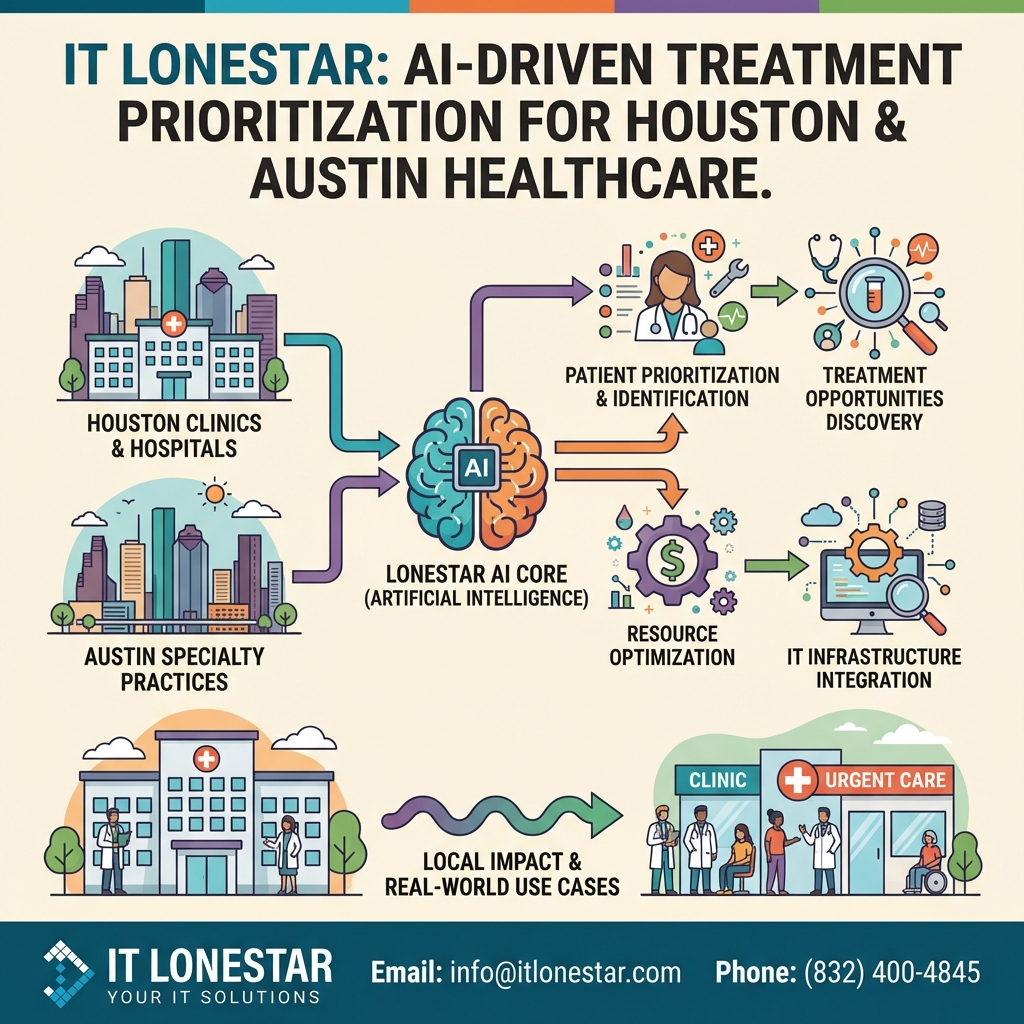
IT LONESTAR helps healthcare providers in Houston and Austin use AI to systematically uncover treatment opportunities that were previously hidden in their data.
1. Data integration and cleanup
– We connect to EHRs, practice management systems, lab platforms, imaging tools, and CRM/patient engagement apps you already use.
– Our team standardizes and cleans the data so AI models can reliably recognize patterns across locations, providers, and specialties.
2. AI models tailored to local workflows
– For Houston and Austin clinics, we train and tune models based on your specialties (primary care, cardiology, oncology, behavioral health, urgent care, etc.).
– These models scan records to spot care gaps, such as overdue follow-ups, missing screenings, high-risk patients without active care plans, duplicate medications, or abnormal test values with no documented response.
3. Real-time treatment opportunity alerts
– Providers and care coordinators receive prioritized worklists instead of generic reports, directly in the tools they already use.
– For example:
– Identifying diabetic patients in Houston whose A1C is trending upward but have no recent medication review.
– Spotting Austin cardiology patients with concerning blood pressure logs and no scheduled follow-up.
4. Risk stratification and population health
– AI scores patients by clinical risk and likelihood of deterioration, not just by diagnosis.
– This helps health systems in both cities focus limited resources on high-impact interventions: care management calls, telehealth check-ins, medication reconciliation, and personalized treatment plan updates.
5. Automation with human oversight
– Routine tasks—like reminders, pre-visit questionnaires, or education messages—are automated, but final clinical decisions stay with licensed providers.
– IT LONESTAR designs workflows so your team stays in control, with clear explanations of why each case is flagged.
6. Security, compliance, and local support
– Systems are built to be HIPAA-compliant, with encryption and strict access controls.
– Our Houston and Austin-based support teams collaborate directly with your staff to refine alerts, reduce noise, and continuously improve model performance.
Through this end-to-end approach, IT LONESTAR turns raw healthcare data in Houston and Austin into actionable insights that support faster diagnoses, better chronic disease management, and more precise treatment strategies—all without disrupting your current IT environment.