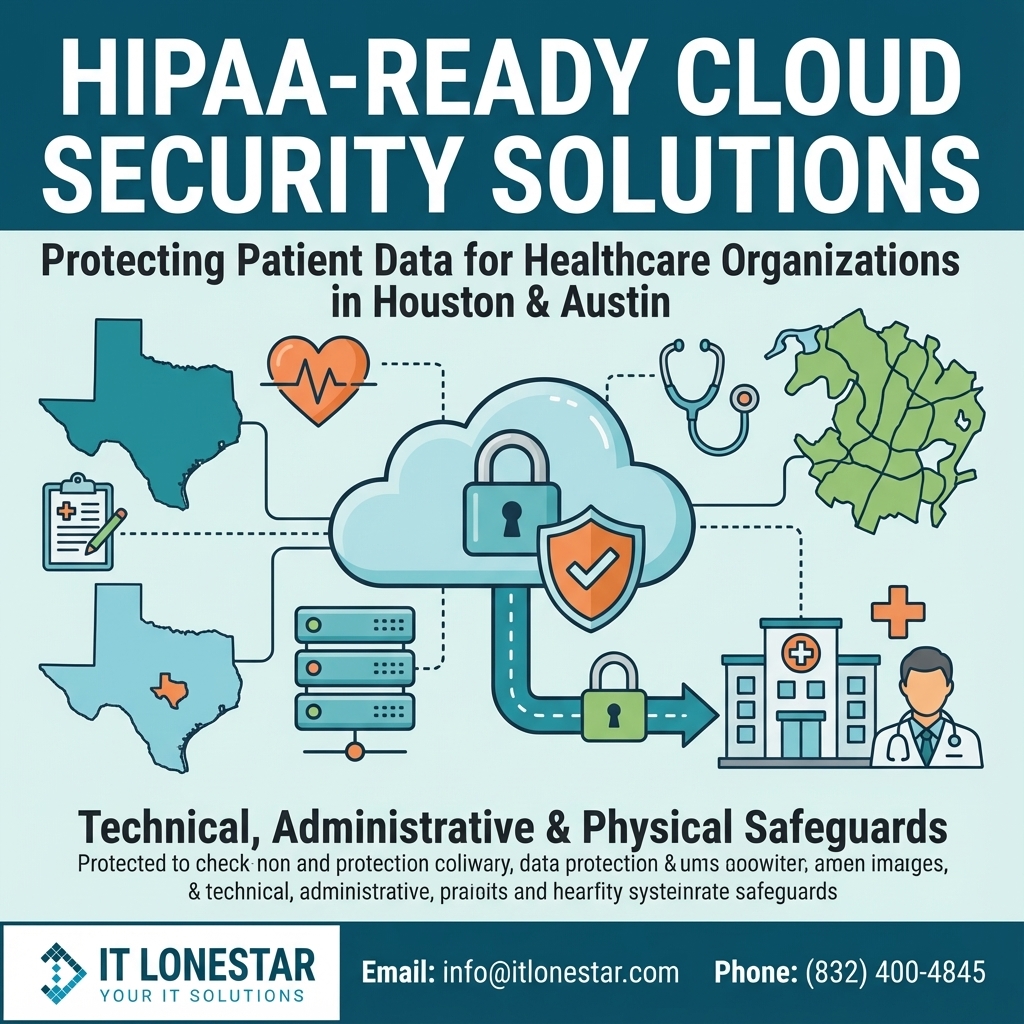
IT LONESTAR secures patient data in the cloud for Houston and Austin healthcare organizations by combining architecture, operations, and compliance into one managed solution.
1) HIPAA-Ready Cloud Architecture
– We design cloud environments (Microsoft 365, Azure, secure hosting, and hybrid setups) following HIPAA and NIST best practices.
– Protected Health Information (PHI) is segmented into dedicated, access-controlled workloads.
– All PHI is encrypted in transit (TLS 1.2+) and at rest with strong key management policies.
– Data backups are encrypted, versioned, and stored in geographically appropriate, compliant regions.
2) Identity, Access & Endpoint Protection
– We implement least-privilege access using role-based access control (RBAC) for staff, clinicians, and vendors.
– Multifactor authentication (MFA) is enforced for all administrative and remote access.
– Endpoint protection and EDR are deployed on workstations, laptops, and mobile devices used across Houston and Austin offices.
– Device compliance policies ensure that only healthy, encrypted devices can access PHI in the cloud.
3) Continuous Monitoring, Logging & Incident Response
– Centralized logging and SIEM monitoring provide full visibility into access to patient records.
– Alerts are configured for suspicious logins, anomalous data downloads, and privilege changes.
– We establish and maintain incident response runbooks aligned with HIPAA breach notification requirements.
– Regular security testing and vulnerability management keep cloud workloads hardened against new threats.
4) Compliance Alignment & Documentation
– IT LONESTAR maps technical controls directly to HIPAA Security Rule safeguards.
– We assist with risk assessments, policy development, and documentation tailored to Houston and Austin practices.
– Business Associate Agreements (BAAs) are executed with appropriate cloud providers and with IT LONESTAR.
– We prepare organizations for audits by maintaining evidence of controls, training, and incident handling.
5) Local, Healthcare-Focused Support
– Our team understands the unique mix of hospitals, specialty clinics, dental offices, and telehealth providers in the Houston and Austin areas.
– We provide onsite and remote support, user training, and ongoing optimization to ensure clinicians stay productive while systems remain secure.
By partnering with IT LONESTAR, healthcare organizations in Houston and Austin get a fully managed, HIPAA-ready cloud security posture—reducing risk, protecting patient trust, and enabling safe digital transformation.